What Are FCL and LCL? Definitions That Actually Make Sense
Every ocean freight shipment moves inside a standard ISO shipping container. What differs between FCL and LCL is who is using that container — and that single distinction cascades into radically different cost structures, timelines, paperwork flows, and risk profiles.
FCL — Full Container Load
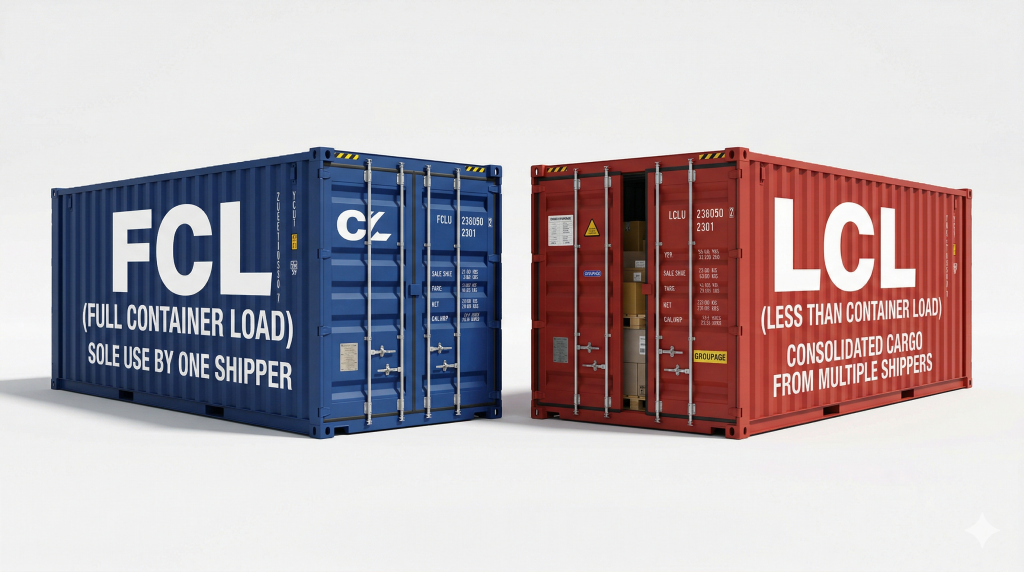
FCL (Full Container Load) means a single shipper books and fills an entire container exclusively for their cargo. Nobody else’s goods share that container. The shipper pays for the entire container — regardless of whether they fill it completely.
The container is sealed at the shipper’s warehouse or factory, transported to the port, loaded on the vessel, and unsealed only at the consignee’s facility at the destination. This door-to-door sealed journey is the defining characteristic of FCL.
Standard FCL container sizes:
| Container Type | External Length | Internal Volume | Maximum Payload |
| 20ft Standard (TEU) | 20 feet / 6.1m | ~33 CBM | ~28,000 kg |
| 40ft Standard (FEU) | 40 feet / 12.2m | ~67 CBM | ~26,500 kg |
| 40ft High Cube (40HQ) | 40 feet / 12.2m | ~76 CBM | ~26,300 kg |
| 45ft High Cube | 45 feet / 13.7m | ~86 CBM | ~27,600 kg |
Practical rule of thumb: If your cargo fills more than 15 CBM of a 20ft container or more than 25–28 CBM of a 40ft container, FCL is almost always cheaper per CBM than LCL.
LCL — Less than Container Load
LCL (Less than Container Load) means multiple shippers share a single container. Each shipper pays only for the space their cargo actually occupies — measured in CBM (cubic metres) or weight tonnes, whichever is greater.
The consolidation and deconsolidation of LCL cargo is managed by a NVOCC (Non-Vessel Operating Common Carrier) or freight forwarder acting as a consolidator. The consolidator:
- Receives cargo from multiple shippers at a CFS (Container Freight Station) at origin
- Packs all shipments into a single container in the most space-efficient arrangement
- Issues a House Bill of Lading (HBL) to each individual shipper
- At destination, the container is deconsolidated at a CFS — cargo is separated and released to each consignee
LCL is charged per W/M (Weight/Measurement ton): 1 W/M = 1 metric tonne (1,000 kg) OR 1 CBM, whichever revenue generates more for the carrier. For most packaged cargo, CBM is the billing basis.
FCL vs LCL — The Definitive Comparison Table {#compare}
The table below covers every dimension that matters for a real shipping decision. Study the differences carefully — several of them are counterintuitive.
| Factor | FCL | LCL |
| Minimum cargo volume | No minimum — you pay for the whole container | Typically 1 CBM minimum (some consolidators: 0.5 CBM) |
| Maximum cargo volume | Up to the container’s rated capacity | Typically up to 15 CBM per shipment before FCL becomes cheaper |
| Pricing basis | Per container (flat rate regardless of fill) | Per CBM or W/M ton (you pay only for space used) |
| Typical cost-efficiency threshold | Economical from ~10–15 CBM upward | Most economical below 10–15 CBM |
| Transit time | Faster — no CFS handling at origin or destination | Slower — add 2–6 days each end for CFS consolidation/deconsolidation |
| Cargo security | High — sealed from origin to destination | Lower — container opened at CFS; multiple handlings |
| Damage risk | Lower — single load, no co-mingling | Higher — multiple handlings; contact with other shippers’ cargo |
| Customs clearance | Straightforward — one consignee, one entry | More complex — can trigger exam if co-loaded cargo is flagged |
| Document type | Master Bill of Lading (MBL) issued by carrier | House Bill of Lading (HBL) issued by consolidator; MBL covers the whole container |
| Who issues the BOL | The ocean carrier | The NVOCC/consolidator (HBL); ocean carrier issues MBL to consolidator |
| Suitable for temperature-sensitive cargo | Yes — reefer FCL containers available | Limited — reefer LCL is rare and expensive |
| Suitable for hazardous goods (DG) | Yes — with proper DG declaration | Very restricted — co-loading DG with general cargo has strict limits |
| Suitable for oversized / OOG cargo | Yes — open-top, flat-rack FCL options | No — OOG cargo cannot be consolidated |
| Suitable for high-value cargo | Preferred — minimises handling and exposure | Higher risk — multiple handlings increase theft/damage exposure |
| Cargo insurance implication | Standard ICC-A policy applies cleanly | May require additional coverage for CFS handling legs |
| Customs exam risk | Exam risk isolated to your container | Exam of a co-loaded container can hold ALL cargo in that box |
| Empty return obligation | Shipper must return empty container within detention free days | No — consolidator manages container return |
| Demurrage exposure | Yes — container on terminal clock ticking | Less direct — consolidator manages D&D |
| Booking lead time | 1–2 weeks before sailing (peak: 3–4 weeks) | 3–7 days before sailing (more flexible) |
| Best for | Regular, high-volume importers/exporters | SMEs, sample shipments, new-to-export businesses |
FCL vs LCL Decision Matrix — Find Your Answer in 60 Seconds {#matrix}
[→ See the interactive decision matrix widget below]
Not sure which to choose? The matrix maps your cargo volume, product type, urgency, and value against the optimal shipping mode — giving you a clear recommendation with reasoning.
The simplest version of the decision:
| Your Cargo Volume | Recommended Mode | Why |
| Less than 5 CBM | LCL always | An FCL would cost 10–15× more than you need |
| 5–10 CBM | LCL usually | Still within LCL’s cost-efficient range; check FCL promo rates |
| 10–15 CBM | Compare both | The break-even zone — get quotes for both and compare |
| 15–28 CBM (20ft) | FCL (20ft) | FCL rate per CBM now beats LCL; you get speed + security |
| 28–67 CBM (40ft) | FCL (40ft) | 40ft is the workhorse container — almost always right at this volume |
| Above 67 CBM | Multiple FCL | Book multiple containers; don’t try to stretch into 45ft unless you need height |
But volume is not the only factor. Override the volume rule and choose FCL when:
- Your cargo is temperature-sensitive (reefer required)
- Your cargo is high-value (jewellery, electronics, luxury goods)
- Your cargo contains dangerous goods
- You are working to a hard delivery deadline and transit time is critical
- Your cargo is fragile and cannot withstand multiple handlings
- You are shipping under a Letter of Credit where document integrity is paramount
Override the volume rule and choose LCL when:
- Your cargo is below 10 CBM, period
- You are testing a new market with a small trial order
- Your production schedule means goods won’t be ready for a full container
- Your buyer needs partial delivery urgently while the rest of production finishes
- You cannot tolerate the cash flow impact of paying for a full container upfront
How LCL Consolidation Works — Step by Step {#consolidation}
Understanding the consolidation process is essential for LCL shippers — because most of the additional time and risk in LCL comes from these extra steps that FCL never has.
The 10-Step LCL Journey
Step 1 — Booking with the consolidator The shipper (or their freight forwarder) books LCL space with a consolidator (NVOCC). The booking specifies the CBM and weight, the commodity, the origin CFS, and the destination CFS. The consolidator checks the weekly sailing schedule and assigns the shipment to a specific consolidation.
Step 2 — Cargo delivery to CFS at origin The shipper delivers their cargo to the consolidator’s nominated CFS (Container Freight Station) at the origin port city. This is a licensed bonded warehouse where cargo is received, weighed, measured, and logged. The CFS issues a Cargo Receipt — this is critical evidence confirming the cargo was delivered in good condition.
Step 3 — CFS intake and measurement CFS staff measure each shipment’s actual dimensions and weight. The billing CBM is confirmed here — and if your cargo measures more than you declared, you will be billed for the higher figure. Tip: Always measure your cargo accurately before booking to avoid surprises.
Step 4 — Consolidation (stuffing) The CFS combines multiple shippers’ cargo into a single container in the most space-efficient arrangement possible. This is a skilled operation — good consolidators minimise dead space while ensuring cargo is properly secured and separated. The container is sealed and a single MBL is issued to the consolidator.
Step 5 — House Bill of Lading issued For each individual shipper, the consolidator issues a House Bill of Lading (HBL). This is your primary transport document — it names you as the shipper, your buyer as consignee, and references the consolidator’s MBL. The HBL (not the MBL) is what you present to your bank in an LC transaction.
Step 6 — Port handling and ocean voyage The stuffed container moves through the port and is loaded on the ocean vessel exactly like an FCL container. The voyage itself is identical.
Step 7 — Deconsolidation CFS at destination At the destination port, the container is discharged and delivered to the destination CFS — typically operated by the consolidator’s partner agent. The container is opened and each consignment is physically separated and identified.
Step 8 — Individual customs clearance Each consignee clears their own cargo through customs at the destination CFS. This is done using the HBL as the primary document. If one consignee’s cargo is selected for physical examination, it typically only affects that shipment — but if the container itself is selected for examination (which the customs system may do based on the container number), all cargo in the box can be held.
Step 9 — Cargo release Once customs is cleared and destination CFS charges are paid (destination handling, CFS deconsolidation fee, document fees), the cargo is released to the consignee or their nominated cartage agent.
Step 10 — Last-mile delivery The consignee arranges collection or the forwarder arranges delivery to the final address.
Key LCL Charges to Know
| Charge | What It Is | Who Charges It |
| Ocean freight | Per CBM or W/M rate for the voyage | Consolidator (NVOCC) |
| Origin CFS handling | Receiving, measuring, stuffing charge at origin CFS | CFS operator |
| Documentation fee | HBL issuance fee | Consolidator |
| Destination handling (DHC) | Deconsolidation and handling at destination CFS | Destination CFS / agent |
| Destination delivery order (DDO) | Fee to release the HBL cargo from the consolidator | Destination agent |
| Customs examination | If selected — can apply to individual cargo or whole container | Customs authority |
| Storage at CFS | If cargo not collected within free storage period | CFS operator |
FCL vs LCL Costs — The Full Breakdown {#costs}
[→ See the interactive cost comparison calculator below]
Freight cost is where most FCL vs LCL decisions actually get made — but most shippers only look at the ocean freight line item and miss the full picture.
What Goes Into the Total FCL Cost
For a 20ft FCL from Shanghai to Mumbai (indicative 2026 rates):
| Cost Element | Typical Range (USD) |
| Ocean freight (base rate) | $800 – $1,800 |
| Origin THC (Terminal Handling Charge) | $150 – $250 |
| Documentation fee (BL fee) | $50 – $100 |
| Origin port surcharges (BAF, EBS, etc.) | $100 – $350 |
| Destination THC | $180 – $280 |
| Destination port surcharges | $80 – $200 |
| Customs brokerage (origin + destination) | $150 – $300 |
| Total estimated range (20ft FCL) | $1,510 – $3,280 |
At 20 CBM of cargo, this works out to approximately $75 – $164 per CBM all-in.
What Goes Into the Total LCL Cost
For a 5 CBM LCL shipment from Shanghai to Mumbai (indicative 2026 rates):
| Cost Element | Typical Range (USD) |
| Ocean freight (per CBM) | $35 – $75 per CBM → $175 – $375 total |
| Origin CFS handling | $25 – $45 per CBM → $125 – $225 total |
| Documentation / HBL fee | $50 – $100 flat |
| Origin port surcharges | $15 – $30 per CBM → $75 – $150 total |
| Destination handling (DHC) | $40 – $80 per CBM → $200 – $400 total |
| Destination delivery order | $50 – $120 flat |
| Customs brokerage | $100 – $250 flat |
| Total estimated (5 CBM LCL) | $775 – $1,620 |
At 5 CBM, this is approximately $155 – $324 per CBM all-in.
The Break-Even Analysis
This is the single most useful calculation in the FCL vs LCL decision:
Break-even CBM = Total FCL all-in cost ÷ Total LCL all-in rate per CBM
If the FCL all-in cost is $2,000 and the LCL rate is $150/CBM all-in: Break-even = $2,000 ÷ $150 = ~13.3 CBM
This means: if your cargo is above 13.3 CBM, FCL is cheaper. Below 13.3 CBM, LCL is cheaper. The break-even point shifts based on freight market conditions — it typically rises when FCL rates drop (making FCL more attractive at smaller volumes) and falls when LCL rates are highly competitive.
Hidden Costs That Tip the Calculation
LCL hidden costs:
- CFS storage if customs clearance is delayed
- Minimum charge (most consolidators charge a minimum of 1–2 CBM even for smaller cargo)
- Repacking or repalletising fees at CFS if cargo doesn’t meet handling standards
- Destination DDO fees (often quoted separately and surprise first-time LCL importers)
FCL hidden costs:
- Demurrage if customs takes longer than free days
- Detention if you can’t unload and return the empty box within the free period
- VGM submission fee (carrier requirement)
- Chassis or inland transport (in US trade: chassis hire is a significant add-on)
Major LCL Consolidation Hubs — Global Reference
The consolidation hub you use has a direct impact on your LCL transit time, rate, and service quality. Here are the world’s most important LCL consolidation centres.
Asia (Origin) Hubs
| Hub | Port Code | Key Trade Lanes | Notable Consolidators Active |
| Shanghai | CNSHA | All global trade lanes | Panalpina, Kuehne+Nagel, DB Schenker, Expeditors |
| Shenzhen / Yantian | CNSZX / CNYTN | Asia–Americas, Asia–Europe | All major NVOCCs |
| Ningbo | CNNGB | Asia–US, Asia–EU | Strong LCL market for chemical/textile cargo |
| Guangzhou / Nansha | CNGZH | Southeast Asia, Middle East | Active hub for India-bound LCL |
| Singapore | SGSIN | Southeast Asia hub; Asia–Europe | PSA CFS; transshipment LCL specialist |
| Colombo | LKCMB | Indian subcontinent gateway | Key transshipment LCL for India, Bangladesh, Sri Lanka |
| Mumbai (JNPT) | INNSA | India imports | CONCOR CFS, numerous private CFS operators |
| Chennai | INMAA | South India; India–SE Asia | Growing LCL market |
| Busan | KRBSN | Korea–North America, Korea–Europe | Strong tech cargo LCL |
| Hong Kong | HKHKG | South China; regional consolidation | Declining volume but still active |
Europe Hubs
| Hub | Port Code | Key Trade Lanes | Notes |
| Rotterdam | NLRTM | All European trade; transatlantic | Europe’s largest LCL hub; best European connectivity |
| Antwerp | BEANR | North/Central Europe; Africa | Strong consolidation market for Africa-bound cargo |
| Hamburg | DEHAM | North Europe, Baltic, Scandinavia | Key hub for Germany and Northern European LCL |
| Felixstowe | GBFXT | UK imports/exports | Primary UK LCL gateway |
| Le Havre | FRLEH | France; West Africa | Gateway for French-speaking African markets |
Americas Hubs
| Hub | Port Code | Key Trade Lanes | Notes |
| Los Angeles / Long Beach | USLAX / USLGB | Trans-Pacific; Asia–US West Coast | Largest US LCL gateway |
| New York / New Jersey | USNYC | Asia–US East Coast; Europe–US | Major USEC LCL hub; significant congestion risk |
| Miami | USMIA | Latin America; Caribbean | Gateway for Central/South America LCL |
| Houston | USHOU | Mexico, Latin America | Strong petrochem and industrial LCL |
| Santos | BRSSZ | Brazil imports | South America’s largest LCL market |
Middle East & Africa Hubs
| Hub | Port Code | Key Trade Lanes | Notes |
| Jebel Ali (Dubai) | AEJEA | All global routes; India–UAE | World’s 9th largest port; regional LCL distribution hub for Middle East |
| Salalah | OMSLL | Asia–Europe transshipment | Growing transshipment LCL hub |
| Mombasa | KENMBA | East Africa | Gateway for Kenya, Uganda, Rwanda LCL |
| Durban | ZADUR | South Africa | Key gateway for sub-Saharan Africa |
| Dar es Salaam | TZDAR | East/Central Africa | Landlocked country gateway |
H2: FCL vs LCL — Honest Pros & Cons {#pros}
After all the analysis, here is the cleanest assessment of each mode’s real-world strengths and weaknesses.
FCL — The Full Picture
FCL Advantages
Speed: FCL moves faster end-to-end. There is no waiting for a consolidation to fill up, no CFS dwell time at origin, and no deconsolidation queue at destination. For urgent cargo, FCL can save 3–10 days over LCL on the same trade lane.
Security: The container is sealed at the factory or warehouse and opened only at the consignee’s facility. No third party touches the cargo between origin and destination. This dramatically reduces pilferage, contamination, and handling damage risk.
Documentation simplicity: One shipper, one BOL, one customs entry. There is no HBL/MBL hierarchy to navigate, no co-shippers to worry about, and no consolidator in the middle of your document chain.
Suitability for complex cargo: FCL is the only option for reefer (refrigerated) cargo, dangerous goods at scale, out-of-gauge (OOG) cargo, and any shipment where physical integrity from origin to destination is non-negotiable.
Predictable costing: You know the container rate when you book. There are no per-CBM measurement surprises. If your cargo is lighter or denser than expected, the price doesn’t change.
Control over vessel and sailing: You book directly on a specific vessel and sailing. You know exactly which vessel your cargo is on and when it departs.
FCL Disadvantages
Cost at low volumes: If you are shipping 3–8 CBM, an FCL container costs 3–6× more than LCL per CBM. The container rate is fixed whether you fill it or not.
D&D exposure: Every FCL container comes with a demurrage and detention clock. If customs delays your clearance or your logistics aren’t ready, daily charges accumulate rapidly (see our demurrage guide for full detail).
Empty return obligation: You must return the empty container to a nominated depot within the detention free period. This requires operational planning — particularly for inland destinations.
Minimum viable volume requirement: FCL only makes economic sense from roughly 10–15 CBM. Below that, you are effectively subsidising empty space.
LCL — The Full Picture
LCL Advantages
Cost at small volumes: LCL is dramatically cheaper for shipments under 10 CBM. A 3 CBM shipment in LCL might cost $400–600 all-in; the same cargo in FCL would require paying for a 20ft container at $1,500–2,500.
Flexibility: LCL departures are frequent (often weekly or bi-weekly on major lanes), bookings can be made closer to the cargo-ready date, and minimum volumes are low. This makes LCL ideal for businesses with irregular or small shipment patterns.
No D&D exposure: You don’t own or operate a container. The consolidator manages the box, its terminal time, and its return. Your D&D exposure is limited to CFS storage — which is typically cheaper and more forgiving than port demurrage.
Market entry and sampling: LCL is the natural choice for businesses testing a new market with a trial order, sending samples at commercial quantities, or building a new supplier relationship without committing to full container volumes.
Cash flow: Paying for 3 CBM of LCL space has a fraction of the upfront freight cost of an FCL. For SMEs managing tight cash flow, this matters.
LCL Disadvantages
Transit time: LCL is categorically slower than FCL. Add 2–5 days at origin for consolidation, and another 2–5 days at destination for deconsolidation. On an Asia–Europe trade lane with a 25-day ocean voyage, this can mean LCL takes 32–35 days versus 28 days for FCL.
Cargo co-mingling risk: Your cargo shares a container with strangers. If another shipper’s cargo leaks, smells, or is misdeclared as DG, your cargo can be affected. This risk is real and is why insurance for LCL shipments should always include CFS handling coverage.
Customs exam contamination: If a customs authority flags the container for examination (based on the MBL/container number rather than your individual HBL), all cargo in the box is held pending the exam — even if your consignment is perfectly compliant.
Documentation complexity: The HBL/MBL two-layer document structure is confusing for first-time shippers. Banks handling Letters of Credit need to understand the hierarchy, and some older LC terms explicitly require an MBL — which the consolidator holds, not you.
Limited suitability for special cargo: Reefer LCL exists but is rare and expensive. DG in LCL is heavily restricted. OOG cargo cannot be consolidated. High-value cargo is better protected in FCL.
CFS minimum charges: Most consolidators charge a minimum (typically 1–2 CBM) even for smaller cargo. A 0.5 CBM shipment will be billed at 1–2 CBM, narrowing the cost advantage for very small consignments.
Quick Reference — FCL vs LCL at a Glance
| “Which is better if…” | Answer |
| My cargo is under 5 CBM | LCL — always |
| My cargo is 10–15 CBM | Get both quotes — calculate break-even |
| My cargo is over 20 CBM | FCL — almost always |
| I need it there fast | FCL |
| I’m shipping electronics worth $200,000 | FCL |
| I’m testing a new market with 200 units | LCL |
| My cargo is perishable / needs temperature control | FCL reefer |
| I want the cheapest possible option for 3 CBM | LCL |
| My cargo includes dangerous goods | FCL (Class 1, 7 always FCL) |
| I’m a small business with unpredictable volumes | LCL |
| I’m a regular importer moving 20+ TEU/month | FCL with carrier contract |
- Placement: Within the costs section, after the break-even analysis paragraph
Tracking Your FCL or LCL Shipment
Whether you ship FCL or LCL, tracking your container in transit is essential — especially to monitor vessel arrival and avoid demurrage.
For FCL shipments, you can track by the container number (e.g., MSCU 234781 6) directly on TraceContainer.com. Enter the container number and get real-time vessel position, ETA, and port milestone events.
For LCL shipments, track using your container number (the consolidator should provide it) or your HBL number. The tracking will show the container-level movement — including when it arrives at the destination CFS, which tells you exactly when to have your customs broker ready.
Pro tip for LCL shippers: The moment TraceContainer shows your container as “Discharged” at the destination port, contact your destination CFS agent immediately to confirm deconsolidation scheduling and avoid CFS storage charges.
Rates and transit times referenced are indicative 2026 market data. Actual rates vary significantly by carrier, season, trade lane, and cargo type. Always obtain competitive quotes from at least 3 freight forwarders before booking.