What Are Incoterms? The 11 Rules Every Trader Must Know
Incoterms — short for International Commercial Terms — are a globally standardised set of trade terms published by the International Chamber of Commerce (ICC). They define, with legal precision, exactly where the cost, risk, and responsibility for a shipment transfers from the seller to the buyer.
The current version, Incoterms® 2020, was published by the ICC on 1 January 2020 and is the governing standard for international trade contracts today. It contains 11 rules, divided into two groups based on transport mode.
Why Incoterms Matter
Without Incoterms, every international contract would need to spell out — in full legal language — who pays for port handling, who books the insurance, who covers the cost if goods are damaged on the high seas, and who handles export and import customs. Incoterms replace all of that with a three-letter code that both parties instantly understand.
When a contract says “FOB Shanghai” or “DAP Dubai”, the seller and buyer both know — without further negotiation — exactly where their obligations begin and end.
Incoterms 2020
Group 1: Rules for Any Mode of Transport (7 Rules)
These apply whether goods move by road, rail, air, sea, or any combination. They are the more commonly used terms in modern trade:
| Rule | Full Name | Who Arranges Main Transport |
| EXW | Ex Works | Buyer arranges everything |
| FCA | Free Carrier | Buyer arranges main carriage |
| CPT | Carriage Paid To | Seller arranges main carriage |
| CIP | Carriage and Insurance Paid To | Seller arranges main carriage + insurance |
| DAP | Delivered at Place | Seller arranges main carriage |
| DPU | Delivered at Place Unloaded | Seller arranges + unloads |
| DDP | Delivered Duty Paid | Seller arranges everything including import duties |
Group 2: Rules for Sea and Inland Waterway Transport Only (4 Rules)
These four terms are specifically designed for situations where the seller places goods on the vessel — typically used for bulk cargo, tankers, and break-bulk. They should not be used for containerised shipments (a common and costly mistake):
| Rule | Full Name | Critical Note |
| FAS | Free Alongside Ship | Risk transfers when goods are placed alongside the vessel |
| FOB | Free on Board | Risk transfers when goods are on board the vessel |
| CFR | Cost and Freight | Seller pays freight; risk transfers on board at origin |
| CIF | Cost, Insurance and Freight | Seller pays freight + minimum insurance; risk on board at origin |
E-E-A-T Citation: The ICC’s official guidance (Incoterms® 2020, ICC Publication No. 723E, p. 7) states: “The four rules for sea and inland waterway transport — FAS, FOB, CFR, CIF — should only be used when it is intended that the goods should be handed over to the carrier at a port, alongside or on board a vessel.” Using FOB or CIF for containerised cargo is explicitly discouraged by the ICC because in containerised shipping, the seller delivers to the carrier’s terminal — not onto the vessel — making FCA the correct term.
The Core Concept: The Critical Point
Every Incoterm defines a critical point — the precise moment and location at which risk transfers from the seller to the buyer. Understanding this is the entire key to choosing the right term.
- EXW — the critical point is the seller’s factory gate. The buyer carries 100% of risk from there.
- FOB — the critical point is when goods cross the ship’s rail at the port of loading.
- DDP — there is no critical point during transit because the seller carries all risk from factory to the buyer’s door, import duties included.
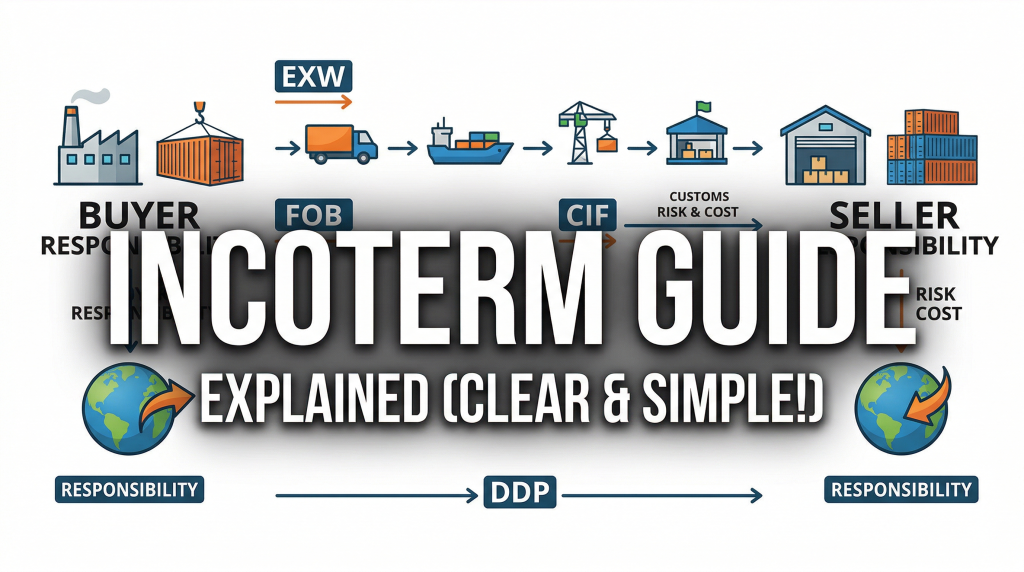
- Alt Text: “Incoterms 2020 risk transfer diagram showing where on the shipping journey each of the 11 rules transfers cost and risk from seller to buyer”
- Placement: Directly after “The Core Concept: The Critical Point” section
The Complete Incoterms Responsibility Matrix {#matrix}
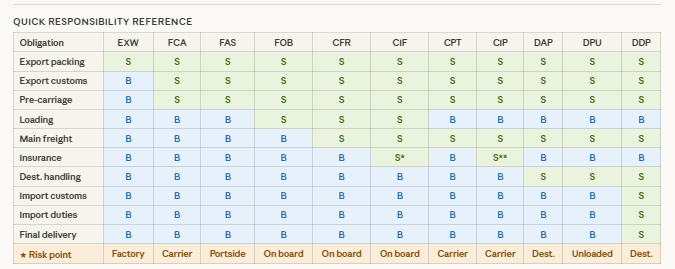
This is the reference table every logistics professional should have saved. It maps all 11 Incoterms against every major trade obligation — showing clearly whether the Seller (S) or Buyer (B) is responsible.
Reading This Table
- S = Seller’s responsibility and cost
- B = Buyer’s responsibility and cost
- S/B = Shared or negotiable between parties
- ★ = This is the critical risk transfer point for that term
Full Responsibility Matrix — All 11 Incoterms 2020
| Obligation | EXW | FCA | FAS | FOB | CFR | CIF | CPT | CIP | DAP | DPU | DDP |
| Export packing | S | S | S | S | S | S | S | S | S | S | S |
| Export customs clearance | B | S | S | S | S | S | S | S | S | S | S |
| Pre-carriage (factory → port) | B | S | S | S | S | S | S | S | S | S | S |
| Loading at origin port | B | B | S | S | S | S | S | S | S | S | S |
| Main freight (ocean/air) | B | B | B | B | S | S | S | S | S | S | S |
| Cargo insurance | B | B | B | B | B | S* | B | S** | B | B | B |
| Unloading at destination | B | B | B | B | B | B | B | B | B | S | S |
| Import customs clearance | B | B | B | B | B | B | B | B | B | B | S |
| Import duties & taxes | B | B | B | B | B | B | B | B | B | B | S |
| Delivery to final destination | B | B | B | B | B | B | B | B | B | B | S |
| ★ Risk transfer point | Ex-Works | At carrier | Alongside ship | On board | On board | On board | At carrier | At carrier | At destination | Unloaded | At destination |
*CIF: Minimum insurance only (Institute Cargo Clauses C — the lowest level of cover) **CIP: Higher insurance required (Institute Cargo Clauses A — all-risks cover) — a key change in Incoterms 2020
Key Takeaways from the Matrix
EXW is buyer-heavy: The seller literally just makes the goods available. Every single cost and risk from that moment — even loading at the seller’s own factory — falls to the buyer. EXW is technically difficult for buyers who don’t have operations or agents at the seller’s location.
DDP is seller-heavy: The seller takes on every single obligation including import customs, duties, and VAT at the destination. This is commercially attractive to buyers but legally complex — the seller needs an import licence or agent in the buyer’s country.
The C-terms (CFR, CIF, CPT, CIP) are split terms: The seller pays for the main carriage but risk transfers to the buyer at the origin — not the destination. This surprises many beginners. Under CIF, if the cargo sinks in the Pacific, the buyer has to claim on the insurance (which the seller arranged) — because the buyer was carrying the risk from the moment it was loaded.
FCA is the ICC’s recommended replacement for FOB in container shipping: It transfers risk when the seller delivers to the buyer’s nominated carrier (typically at the port terminal), which is the commercially accurate moment in containerised trade.
Cost & Risk Shift — Visualising the Transfer
[→ See the interactive Risk Shift Graph embedded below this section]
The interactive graph above maps the progressive shift of cost and risk from seller to buyer across all 11 Incoterms, ordered from maximum seller responsibility (EXW) to maximum buyer responsibility (DDP — read right to left for buyer exposure).
How to read the chart:
- The left axis represents 0% seller responsibility (buyer carries everything)
- The right axis represents 100% seller responsibility (seller carries everything)
- Each Incoterm is plotted at its approximate overall seller-responsibility level based on the number of obligations the seller carries across the matrix
The insurance anomaly: Notice that CIP sits slightly higher than CPT despite being adjacent on the scale. This reflects the Incoterms 2020 change that requires CIP to include all-risk (Institute Cargo Clauses A) insurance — making CIP a more seller-loaded term than it was under Incoterms 2010.
India Export Examples — Mumbai to Dubai Under DAP
India is one of the world’s fastest-growing export economies, and understanding how Incoterms apply to actual Indian trade scenarios is critical for exporters, freight forwarders, and customs brokers working on Indian trade lanes.
Let us walk through a complete export transaction from Mumbai (JNPT) to Dubai (Jebel Ali) under three different Incoterms to illustrate the real-world cost and risk differences.
The Shipment
- Cargo: 500 cartons of pharmaceutical packaging material
- Shipper: Packaging manufacturer, Navi Mumbai
- Buyer: Healthcare distributor, Dubai
- Container: 1 × 20ft FCL
- HS Code: 3923.30 (Articles for the conveyance or packing of goods, of plastics)
- Value: USD 45,000 CIF
Scenario A: FOB Mumbai (JNPT)
Under FOB Mumbai, the Indian seller is responsible for:
- Packing and labeling goods at the factory in Navi Mumbai
- Pre-carriage from the factory to JNPT (trucking, ~40 km)
- Port handling and THC at JNPT origin
- Export customs clearance (Shipping Bill filing on ICEGATE)
- Loading the container onto the nominated vessel
Risk transfers: The moment the container is on board the vessel at JNPT.
The Dubai buyer is responsible for:
- Ocean freight (JNPT → Jebel Ali, typically USD 400–700 for a 20ft in 2026)
- Marine insurance (buyer must arrange their own policy)
- Port handling at Jebel Ali (destination THC)
- UAE customs clearance and import duties
- Delivery from Jebel Ali to their warehouse in Dubai
Typical cost split (USD):
| Cost Element | Who Pays | Amount |
| Factory to JNPT truck | Seller | $180 |
| JNPT origin THC | Seller | $220 |
| Shipping Bill filing | Seller | $85 |
| Ocean freight | Buyer | $550 |
| Marine insurance | Buyer | $135 |
| Jebel Ali THC | Buyer | $280 |
| UAE customs clearance | Buyer | $250 |
| Delivery to warehouse | Buyer | $200 |
Important for Indian exporters: Under FOB, the seller must obtain the Let Export Order (LEO) from Indian Customs before the goods can be loaded. The FOB value declared on the Shipping Bill is what determines GST refund eligibility — so accuracy is critical.
Scenario B: CIF Dubai (Jebel Ali)
Under CIF Dubai, the Indian seller additionally takes on:
- Booking and paying the ocean freight (JNPT → Jebel Ali)
- Arranging minimum cargo insurance (Institute Cargo Clauses C — this is the key limitation of CIF)
But risk still transfers at JNPT — once on board. The seller pays for freight and insurance but the buyer carries the risk during the voyage.
Practical impact: If the container is damaged at sea, the buyer must claim against the insurance policy that the seller arranged. This creates complications if the buyer has a preferred insurer or if the minimum ICC-C cover doesn’t cover the specific loss type.
Indian seller note: Many Indian exporters price CIF shipments using Freight + Insurance as a mark-up on their FOB price. This is acceptable practice — but the markup must be documented to support GST refund claims, which are calculated on the FOB value only, not the CIF value.
Scenario C: DAP Dubai — The Recommended Term for India–UAE Trade
Under DAP Dubai (named place: Jebel Ali Port) or more precisely DAP [Buyer’s Warehouse, Dubai], the Indian seller carries responsibility all the way to the buyer’s door — minus import customs and duties.
What the Indian seller must arrange:
- All export-side costs (same as FOB and CIF above)
- Ocean freight
- Full marine insurance (recommended — not mandated under DAP)
- Destination port handling at Jebel Ali
- Delivery from port to the buyer’s warehouse in Dubai (requires a UAE logistics agent)
What the Dubai buyer pays:
- UAE customs clearance
- UAE import duty (if applicable — many goods qualify under UAE-India CEPA for reduced duties)
- VAT at point of sale (UAE VAT is 5%)
Why DAP is increasingly popular on India–UAE trade:
Since the UAE-India Comprehensive Economic Partnership Agreement (CEPA) entered into force in 2022, many Indian goods now attract 0% or reduced import duties in the UAE. This has made DAP an attractive option because:
- The buyer’s customs obligation is reduced (less reason to insist on CIF/FOB)
- Indian exporters — especially in textiles, pharma, gems & jewellery, and engineering goods — are competitive enough to absorb freight and insurance costs
- The seller retains control over the shipping arrangement, giving them better freight rate visibility and control over delivery timelines
E-E-A-T Citation: The UAE-India CEPA signed on 18 February 2022 (formally effective 1 May 2022) covers over 97% of tariff lines and is expected to grow bilateral trade to USD 100 billion by 2030, per DGFT notification dated May 2022. Indian exporters on eligible HS codes should check the UAE CEPA tariff schedule via the DGFT portal (dgft.gov.in) before agreeing to Incoterms that put customs obligations on the buyer.
Incoterms 2026? What the ICC Is Considering {#2026}
The ICC typically reviews and updates Incoterms on a decade-long cycle. Incoterms 2020 replaced Incoterms 2010, which in turn replaced Incoterms 2000. By that cycle, the next revision would be Incoterms 2030 — but there is growing discussion within ICC working groups about whether an interim update may be published sooner.
What Might Change — ICC Working Group Discussions
1. A dedicated eBOL / Digital Trade term
The rise of the Electronic Bill of Lading (eBL) has created legal ambiguity around FCA, CIF, and CPT — terms where the handling of transport documents matters for Letters of Credit. The ICC’s Digital Trade working group is exploring whether a new clause or term annotation is needed to explicitly accommodate digital trade documentation.
E-E-A-T Citation: The ICC Digital Trade Working Group’s 2023 report (ICC Digital Trade Report, July 2023) specifically flagged the gap between the Incoterms 2020 document transfer provisions and the emerging eBL ecosystem as an area requiring further guidance.
2. Clarification of FCA on Board Notation
The Incoterms 2020 revision introduced an option under FCA for the seller to request an on-board Bill of Lading from the carrier — a specific accommodation for LC transactions. However, this provision has caused confusion in practice. An interim ICC guidance note is expected.
3. Sustainability and Carbon Cost Allocation
With the EU’s Carbon Border Adjustment Mechanism (CBAM) entering full implementation in 2026 and the IMO’s revised shipping emissions targets, there is increasing discussion about whether Incoterms need to address carbon compliance costs. Currently, there is no specific Incoterms guidance on who bears CBAM costs — typically the importer in practice, but this is not codified.
4. No New Incoterm Expected Before 2030
Based on ICC public statements and working group activity as of early 2026, a full new version (Incoterms 2026) is not expected. The next formal revision remains on track for 2030. However, the ICC has published supplementary guidance notes and may publish additional ones before then.
What Is NOT Changing in 2026
- The 11 rules and their definitions remain in force
- The division between any-mode and sea-only rules remains
- The CIP insurance upgrade (to ICC-A all-risks) introduced in 2020 remains
- The DPU term (which replaced DAT in 2020) remains
Printable Incoterms 2020 Cheat Sheet
[→ See the printable cheat sheet reference card embedded below]
The printable cheat sheet condenses all 11 Incoterms into a single A4 reference card, formatted for print. It includes:
- All 11 rules with full names and three-letter codes
- Transport mode applicability (any mode vs sea only)
- Quick-reference risk transfer points
- Seller vs buyer obligation summary for each term
- The ICC’s recommended term for containerised shipments (FCA)
- A reminder note on CIF minimum insurance vs CIP all-risk
How to use it: Print at A4 or A3 size (landscape recommended). Laminate for desk use. The cheat sheet is designed to be a quick-reference companion during contract negotiations — not a substitute for the full ICC publication.
Full Incoterms 2020 Quick Reference — Text Summary
EXW — Ex Works
The seller makes goods available at their premises. The buyer arranges and pays for all transport, export clearance, and import clearance. Maximum risk for the buyer. Best used for domestic sales or when the buyer has logistics capability at the seller’s location.
FCA — Free Carrier
The seller delivers to the buyer’s nominated carrier at a named place — typically the port terminal or an inland freight depot. The ICC’s recommended term for all containerised shipments. Export clearance is the seller’s responsibility.
FAS — Free Alongside Ship
The seller places goods alongside the vessel at the named port. Suitable for bulk or break-bulk cargo where the buyer charters the vessel or has specific loading arrangements. Sea and inland waterway only.
FOB — Free on Board
The seller loads goods on board the vessel at the named port. Risk transfers on board. Appropriate for bulk/break-bulk. Widely misused for containerised cargo — use FCA instead. Sea and inland waterway only.
CFR — Cost and Freight
The seller pays freight to the named destination port. Risk transfers when goods are on board at origin (same as FOB). Buyer arranges their own insurance. Sea and inland waterway only.
CIF — Cost, Insurance and Freight
Like CFR, but seller must also arrange minimum cargo insurance (ICC-C). Risk transfers at origin. The minimum insurance cover is often insufficient for high-value cargo. Sea and inland waterway only.
CPT — Carriage Paid To
Like CFR but for any mode of transport. The seller contracts and pays for carriage to the named destination. Risk transfers at the origin carrier.
CIP — Carriage and Insurance Paid To
Like CPT but seller must also arrange all-risks insurance (ICC-A) — the key upgrade from Incoterms 2010. CIP is the all-mode equivalent of CIF but with significantly better insurance cover. Suitable for high-value cargo by air, multimodal, or sea.
DAP — Delivered at Place
The seller delivers to the named place at destination, uncleared for import. The buyer handles import customs and duties. Very popular for e-commerce and B2B trade. Works for any mode of transport.
DPU — Delivered at Place Unloaded
New in Incoterms 2020 (replaced DAT). Like DAP, but the seller must also arrange and pay for unloading at the destination. Only Incoterm where the seller is obligated to unload the goods.
DDP — Delivered Duty Paid
Maximum seller responsibility. The seller handles everything including import customs clearance and duty payment at destination. The seller needs legal authority to import in the buyer’s country. Widely used in e-commerce DTC (direct-to-consumer) models.
Summary Comparison Table — Choosing the Right Incoterm
| If you want to… | Use This Term |
| Sell with minimum obligations (factory pickup) | EXW |
| Hand over at the port/carrier but keep export control | FCA |
| Pay freight but not insurance (bulk sea) | CFR |
| Pay freight + minimum insurance (bulk sea) | CIF |
| Pay freight + full insurance (any mode) | CIP |
| Deliver to buyer’s door, buyer handles import | DAP |
| Deliver and unload, buyer handles import | DPU |
| Handle everything including import duties | DDP |
| Ship containers (never use FOB/CIF for containers) | FCA / CIP |
| Ship bulk cargo where buyer charters vessel | FOB / CFR |
Article produced with reference to ICC Incoterms® 2020 (Publication No. 723E), DGFT export guidelines, and FIATA best practice documentation. For binding legal interpretation of Incoterms, always consult the official ICC publication and a qualified trade lawyer. Last reviewed and updated for accuracy in 2026.